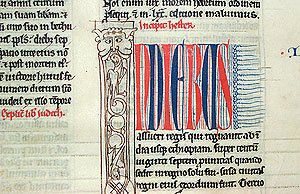
Bible with prologues, the books in the following order: Genesis to Nehemiah omitting Ruth; Judith; Esther; Tobit; Maccabees; the Major and Minor prophets, with a chapter-list for Daniel; Job; parallel Gallican and Hebraic versions of the Psalms; the Sapiential books, with Wisdom before Song of Songs; Gospels; Acts; Pauline and Canonical Epistles; Revelation; and finally Ruth. The order of books and selection prologues varies considerably from the 13th-century norm as defined by Ker, MMBL, I, p. 96-7; II, pp. 210-12, etc.
The 'S.' numbers below refer to prologues using the numbers in Stegmüller, RB: numbers are joined by a '+' indicate that the texts run straight on from one to the next without a break, and are separated by a comma when a decorated initial marks the start of the next prologue.
[Item 1 occupies quires 1-18]
1. (fols. 1r-174v) Prologues S.284 (fols. 1r-3v), and S.285 (fols. 3v-4r), followed by an unwritten column; Genesis (fols. 4v-22r), with 19:35-42:30 missing (from '… dederunt & ||' to '|| prouincie. …'), and replaced on 17th-century paper supply leaves (fols. 11-18); Exodus (fols. 22r-36v); Leviticus (fols. 37r-47v); Numbers (fols. 48r-63r); Deuteronomy (fols. 63r-75r); prologue S.311 (fol. 75r-v), Joshua (fols. 75v-84r); Judges (fols. 84v-93v); I Samuel (fols. 94r-107r); II Samuel (fols.107r-118r); I Kings (fols. 118r-130v); II Kings (fols. 130v-142r); 24 lines left blank, perhaps for a prologue; I Chronicles (fols. 142r-153r); II Chronicles (fols. 153r-166r); I Ezra (fols. 166v-170r), running straight into Nehemiah (with running-title '.ESD. .II.') whose start is marked with a one-line coloured initial (fols. 170r-174v), and whose end occupies part of the gutter margin in order to finish on the last page of a quire.
[Items 2-5 occupy quires 19-49]
2. (fols. 175r-379v) Prologue S.335, Judith (fols. 175r-180v); prologues S.341+343, Esther (fols. 180v-186r); prologue S.332, Tobit (fols. 186r-190r); I Maccabees (fols. 190r-202r); II Maccabees (fols. 202r-209v); prologue S.482, Isaiah (fols. 209v-224v); prologue S.487, Jeremiah (fols. 224v-241r); prologue S.491, Baruch (fols. 241r-243r); 19 lines left blank, perhaps for a prologue; Lamentations (fols. 243r-244v); prologue S.492 (fol. 244v), Ezekiel (fols. 245r-260r); prologues S.494 (fol. 260r-v), and a list of capitula: 'De filiis captiuitatis iudee elegit nabugodonosor rex ut litteras discerent. ... & tulit ei prandium abacuch propheta.' (fol. 260v; cf. MMBL, II, p. 632), Daniel (fols. 261r-268r); prologue S.500 (fol. 268r-v); prologue S.507, Hosea (fols. 268v-271r); prologues S.511+508, 510.1, 509 (fol. 271r-v), Joel (fols. 271v-272v); prologues S.515, 512 (ends '... sed audiendi uerbum dei.'), Amos (fols. 272v-274v); prologues S.519+517, 516 (fols. 274v-275r), Abdias; prologues S.524, 522 (fol. 275r-v), Jonah (fols. 275v-276r); prologues S.526, 525, Micah (fols. 276r-277v); prologues S.528+527 (fols. 277v-278r), Nahum (starting at 1:2: 'Deus emulator …') (fol. 278r-v); prologues S.531, 530, 529 (fols. 278v-279r), Habakkuk (fols. 279v-280r); prologues S.534, 532 (fol. 280r-v), Zephaniah (fols. 280v-281r); prologues S.539(!), 535 (fol. 281r-v), Haggai (fols. 281v-282r); prologue S. 3369 ('Secundo anno Darii filij hitaspis ... regis imperium.'; also found in MS. 55, pp. 746-7, and perhaps typical of England: cf. MMBL, I, pp. 3, 66; II, pp. 409, 653; III, p. 677; IV, p. 221), prologue S.540, Zechariah (fols. 282r-285v); prologue S.543, prologue S.3371, ending at '… in primo mensis quinti uenit in ierusalem.' (PL, XXV, cols. 1541B-1542C; as in MS. 55; cf. MMBL, II, pp. 195, 409, 653; III, p. 677; IV, p. 221), followed without break by prologues S.545+544 (fol. 285v, last 12 lines); Malachi (fols. 286r-286v); prologues S.344, 349+350 (fols. 286v-287r), Job (fols. 287v-296v); prologue S. 443 (fols. 296v-297r), S.414; S.430 (fol. 297r), Psalms 1-150, in parallel Gallican and Hebraic versions (fols. 297v-345v), with the ten-part divisions marked, the Gallican version in the left-hand column, the Hebraic version with psalm tituli in red; lacking Pss. 77:20-64 (from '… inundauerunt ||' to '|| Sacerdotes …') due to the loss of a leaf after fol. 322, and with Pss. 83:6-104:22 (from '… abs te; ||' to '|| Vt erudiret …' in the Gallican version) lost and replaced on 17th-century paper supply leaves (fols. 325-330), the Gallican version with interlinear and marginal glosses only at the start of quire 36 (fols. 342r-343r; Adelaide Louise Bennett, The place of Garrett 28 in thirteenth-century English illumination, Ph.D. dissertation, Columbia University, New York, 1973, chapter II, discusses in some detail Bibles with duplex Psalters, not including the present manuscript); Psalm 151 (S.105,3) (fol. 346r); prologue S.457, Proverbs (fols. 346r-354r), with marginal and interlinear Gloss (S.11802: 3, 2, 5, 4); Ecclesiastes (fols. 354v-357r); Wisdom (fols. 357r-363r); Song of Songs (fols. 363r-364v); Ecclesiasticus (fols. 364v-379v).
3. (fols. 380r-469v) New Testament: prologue S.590, Matthew (fols. 380r-392r); prologue S.607, Mark (fols. 392r-399v); Luke, with 1:1-4 treated as a prologue, the major initial at 1:5 (fols. 400r-413r); prologue S.624, John (fols. 413r-422r), lacking 2:4-4:35 (from '… hora mea ||' to '|| quod ad huc …') due to the loss of a leaf after fol. 413; Acts (preceded by a 28-line space, perhaps for a prologue, subsequently filled with glosses) (fols. 422r-434v); (fols. 434v-459r) Pauline Epistles: Romans (fols. 434v-439r); I Corinthians (fols. 439r-443v), II Corinthians (fols. 443v-446v); Galatians (fols. 446v-448r); Ephesians (fols. 448r-449v); Philippians (fols. 449v-450v); Colossians (fol. 450v-451v); I Thessalonians (fols. 451v-452v), II Thessalonians (fols. 452v-453r); I Timothy (fols. 453r-454r), II Timothy (fols. 454r-455r); Titus (fol. 455r-v); Philemon; Hebrews (fols. 455v-459r); (fols. 459r-464r) Canonical Epistles: James (fols. 459r-460r); prologue S.812, I Peter (fols. 460r-461v); S.818, running straight into II Peter (fols. 461v-462r); I-III John, with only minor initials at the start of each (fols. 462r-463v); Jude (fols. 463v-464r); (fols. 464r-469v) Revelation.
4. (fols. 469v-470v) Ruth.
5. (fol. 471r-v) Added, 13th century: Gospels readings for the year, from Christmas Eve to the Saturday before Lent, only; Thomas Becket does not appear.
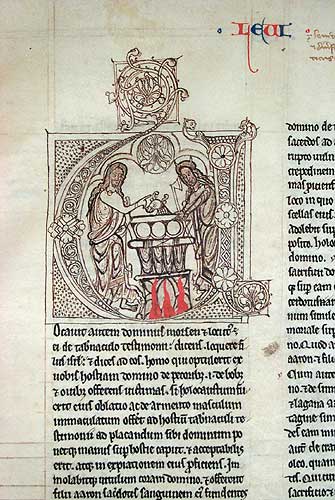
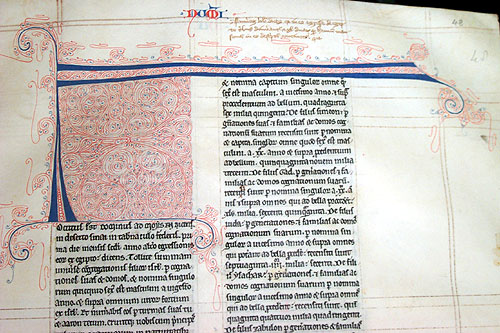
One fine 14-line historiated pen-drawn initial, in brown ink with
touches of red in the faces:
(fol. 37r) Leviticus:
initial 'U', with Aaron pointing to Moses (horned), who holds an axe,
standing either side of a ram on an altar, with red flames (or rivulets of
blood?) below (cf. Leviticus 9:18-21) (Alexander & Temple, pl. VIII no.
158, detail, cited as fol. 36).
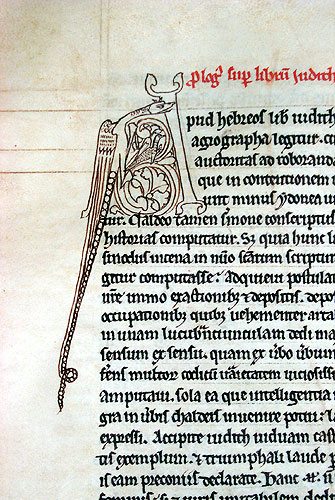
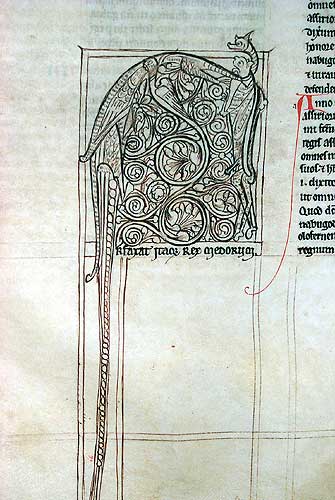
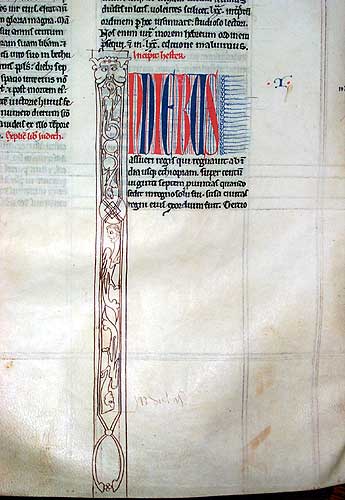
Three fine pen-drawn initials in brown ink, composed of dragons and
hybrids:
(fol. 175r) Judith: initial 'A'(pud),
5-line, and initial 'A'(rfaxat), 14-line, with a
descender extending to the bottom of the page.
(fol. 180v) Esther:
initial 'I'(n), extending to the bottom of the page,
with human-headed hybrids, etc.
Added marginal sketches:
(fol. 186r, lower gutter margin) A
human-headed hybrid, in leadpoint.
(fol. 342r, lower gutter margin) A man's
(tonsured?) head, in red ink.
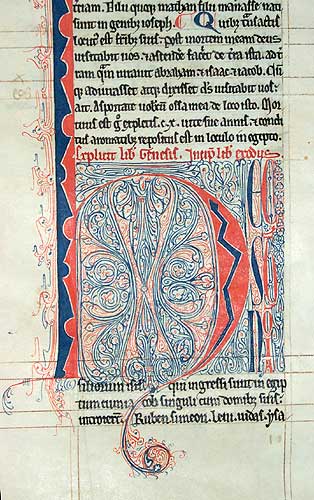
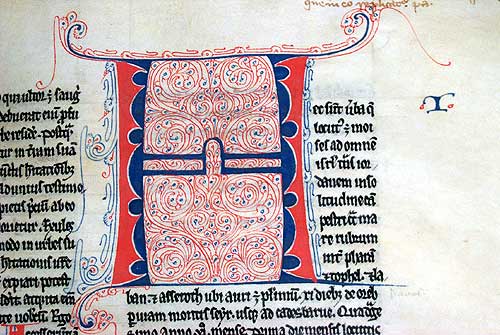
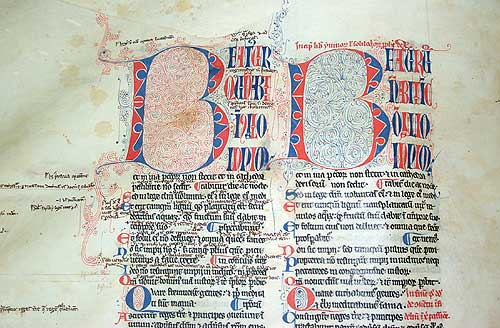
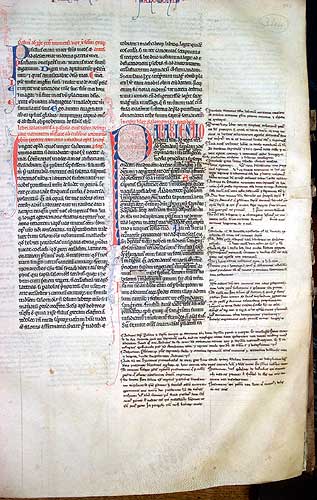
Fine large parted initials, with blue and predominantly red penwork, at the start of biblical books (fols. 1r, 4v, 22r, 48r, 63r, 75v, 84v, 94r, 107r, etc.), similar or simpler initials with predominantly blue penwork to the prologues; and with one of each in the pairs of initials in the parallel versions of the Psalms; smaller initials alternately in red with blue penwork, or vice versa; large attenuated display capitals used for incipits in some books, verse initials, paraphs, running-titles, and chapter numbers in roman numerals, all in alternately red and blue letters. The initial 'L' to the book of Numbers (fol. 48r) is turned 90º clockwise, such that the 'vertical' of the letter lies horizontally across most of the width of the page.
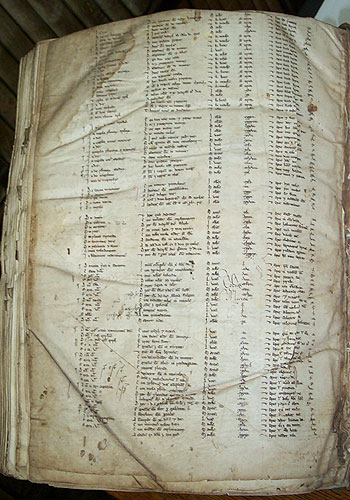
Parchment, c. 425 x 305 mm., of variable quality, with numerous flaws and repairs; the lower margins of a number of leaves torn/cut away; page-marker tabs at the fore-edge are apparently made from an English 15th-century parchment manuscript with pen-flourished decoration (see e.g. fol. 245v).
ff. ii (paper) + 10 (fols. 1-10) + 8 (paper, fols. 11-18) + 306 (fols. 19-324) + 6 (paper, fols. 325-330) + 141 (fols. 331-471) + i (paper, fol. 472); foliated in modern pencil, correcting a very sporadic 19th-century pencil foliation which had skipped a leaf before reaching fol. 142.
Quires mostly of 10 leaves each: 110 (fols. 1-10) | 28 (fols. 11-18) | 3-610 (fols. 19-58), 78 (fols. 59-66), 8-1710 (fols. 67-166), 188 (fols. 167-174) | 19-3210 (fols. 175-314), 3310-1 (9th leaf missing after fol. 322) (fols. 315-323), 3410-8+6 (2nd to 9th leaves missing, replaced by supply leaves) (fols. 324-331), 35-4210 (fols. 332-411), 4310-1 (3rd leaf missing after fol. 413) (fols. 412-420), 44-4810 (fols. 421-460), 4910+1 (11th leaf inserted) (fols. 461-471); quires arranged with a hair-side outermost; catchwords frequently survive; quire signatures in ink in upper-case roman numerals survive in quires 1 and 3-6; leaf signatures in leadpoint are often visible towards the bottom gutter corner, (e.g. start of I Kings), in the form of letters 'a'-'h' with other markings on each page from the first to the fifth recto inclusive.
Ruled in crayon with various ruling patterns, e.g. the top, middle, and bottom pairs extending the full width of the page, between single vertical bounding lines and three inter-columnar lines extending the full height of the page; the space ruled for the main text c. 240 x 155 mm.; prickings survive in the gutter and lower margins.
Written in two columns of 45-47 lines per page, 'above top line', in gothic script, by several scribes (with one change at the start of Judith).
Secundo folio: 'opus est'.
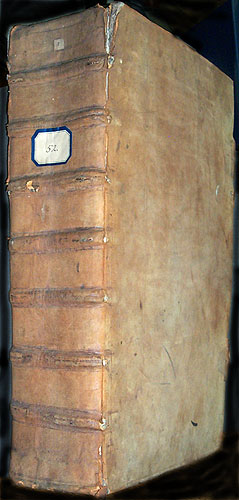
Sewn on seven slit thongs, and bound c.1700 in plain brown reversed calf over pasteboards, framed with simple blind fillets (cf. MS. 309); the endpapers have almost the same watermark as those in MS. 556 (the 1669 catalogue of benefactors) and MS. 362 (bound c.1712); traces of two clasps at the fore-edge, and of a chain-staple towards the top of the fore-edge of the front board (cf. MS. 309); traces of a fore-edge inscription.
1. Written probably in England in the first quarter of the 13th century; a neat scribe, who may also have written item 5 and various marginal glosses, added a note at the end of the General prologues: 'Hic est Ordo bibliotece parisiacensis. Genesis ... Apocalypsis' (fol. 4r); the order given is Genesis to Esther omitting Ruth, Maccabees, Psalms, Major and Minor Prophets, Job, Proverbs, Ecclesiastes, Song of Songs, Ecclesiasticus, Wisdom, Gospels, Acts, Canonical and Pauline Epistles, Revelation; it thus does not correspond exactly to the present manuscript, nor to the usual order of the standard 13th-century 'Paris' Bible. With extensive 13th-century interlinear and marginal annotations glosses, especially from the start of Proverbs to the end of Revelation, excepting Acts; H. H. Glunz, History of the Vulgate in England from Alcuin to Roger Bacon: being an inquiry into the text of some English manuscripts of the Vulgate Gospels (Cambridge, 1933), p. 272, points out that a number are taken from the Gloss (i.e. the glossa ordinaria), suggesting scholastic use of the manuscript. The Gospels have concordance references in the margins, usually in red; sporadically corrected in a neat 14th-century hand (e.g. fol. 150r).
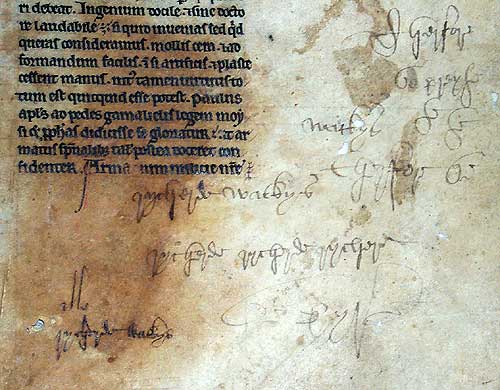
2. Richard Watkys, 14th/15th century: inscribed with his name several times (fols. 1r, 242v).
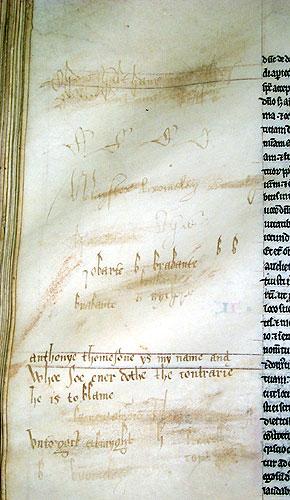
3. Inscribed with numerous 15th- and 16th-century names and phrases: 'anthonye thomesone ys my name …' (fol. 241v; cf. 242r, upside-down); 'robarte brabant' (fol. 241v); 'Wyllyam' (fol. 271r); 'Richard Addams' (fol. 381v); 'elizabeth nonne(?) by name', 'hempton' (fol. 430r, upside-down); 'Tobias May[...]te'(?) (fol. 471v), 'Richard Thoms'(?) (fol. 471v); also inscribed with two alphabets in which many letters form the start of words or names: 'A a amen … e f frend of george gentiles h … l llondon … r r richard s s s t t thomas Thomas v w williams w williams …' (fol. 191v, cf. 242r, including 'george', 'haloweck', and 'Ihon'; cf. 249v).
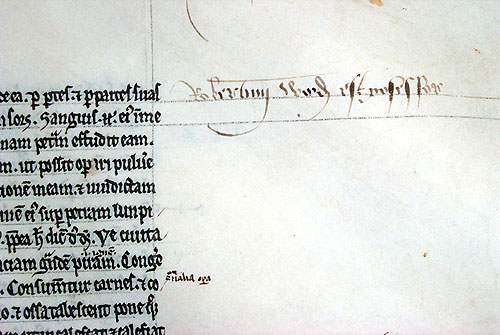
4. Robert Ward, 16th century, perhaps the Dominican friar of this name (on whom see Venn, Alumni Cantabrigienses): inscribed 'Robertum Ward est posessor' (fol. 252r).
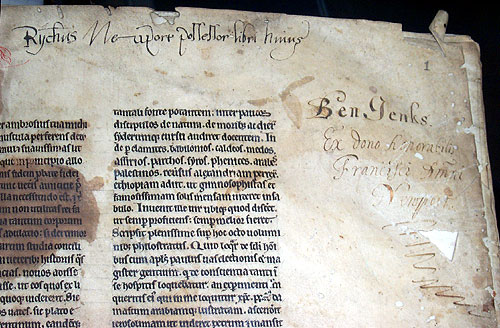
5. Richard Newport (1587-1651), Baron Newport (on whom see DNB): inscribed 'Rych(ard)us Newport possessor libri huius' (fol. 1r; cf. fols. 39r, 197r, and 245r next to the initial).
6. Francis Newport (1619-1708), Earl of Bradford (on whom see DNB), son of Richard.
7. Benjamin Jenks (1646-1724) (on whom see DNB), rector of Harley, co. Salop; given to him by Francis Newport, whose chaplain he was: inscribed 'Ben Jenks. Ex dono honorabilis Francisci Domini Newport' (fol. 1r); the large sketched 'BI' monograms (fol. 470v) are presumably his; inscribed 'the marches of Walles' (fol. 267v, upside-down).
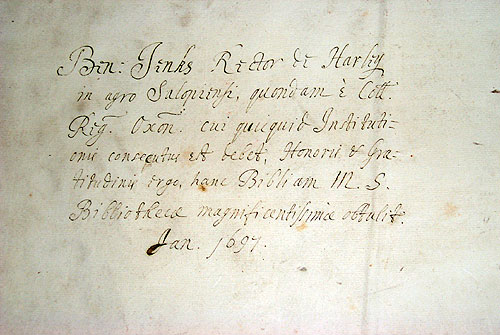
8. Queen's College, given by Jenks in 1697: inscribed 'Ben: Jenks Rector de Harley in agro Salopiensi, quondam è Coll. Reg. Oxon. cui quicquid Institutionis consecutus est debet, Honoris & Gratitudinis ergo, hanc Bibliam M.S. Bibliothecæ magnificentissimæ obtulit. Jan. 1697' (fol. iiv); with the College bookplate and former shelfmarks 'E.1.' (front pastedown) and 'S 15:15' (fol. ir), both crossed through; a paper label at the head of the spine printed 'J' (i.e. '1'); the front pastedown inscribed in pencil '52'.
Coxe, Catalogus, pp. 7-8.
Alexander & Temple, College libraries, no. 158, pl. VII