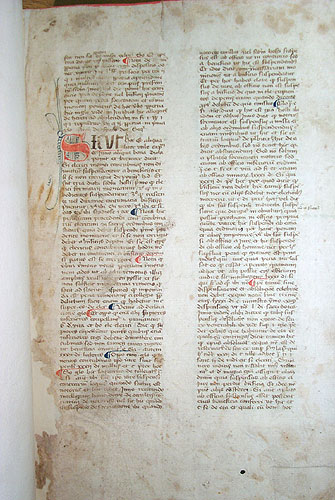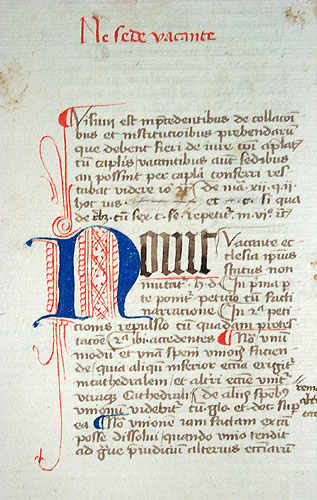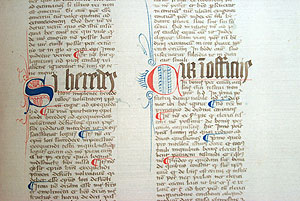
(fols. 1r-329v) Starts imperfect in cap. 4, tit. 2: '||sen non sit \perpetua/ de consti [??] … SICVT. Hoc est aliqualiter vtile capitulum ...'; the first rubric is 'De clericis coniugatis ( fol. 18v); the final rubric is 'De immuniate ecclesiarum' (fol. 320r); text ends imperfect in cap. 8 tit. 49.
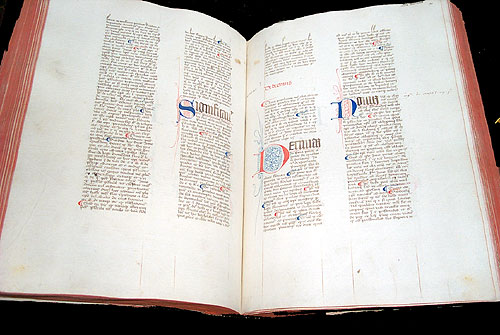
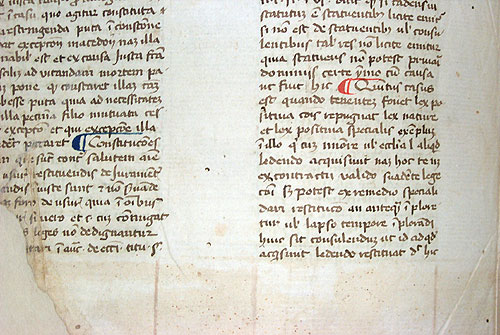
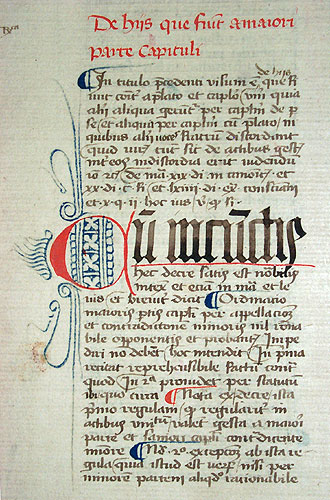
Six- to eight-line initials, alternately red with blue penwork, or vice versa (that on fol. 295r larger and more elaborate than most); paraphs alternately red or blue.
Paper, c. 395 x 285 mm.; watermarks: a triple mount (closest to Briquet 11662: Florence, 1432), and a triple mount within a circle (closest to Briquet 11850: Genoa, 1451), the latter apparently only quires 10 and 11 (see further under Provenance); the lower corner of fol. 80 torn out, fol. 198 almost detached.
ff. vii (paper) + 329 + x (paper); the first two and last two are narrow strips, foliated in modern pencil: i-vii, 1-339.
Quires mostly of ten leaves each: [first quire missing], 110-3 (first? three leaves missing, one of them now bound as fol. 139) (fols. 1-7), 2-710 (fols. 8-67), 810-2 (2 leaves missing in the 2nd half of the quire, apparently 7th & 8th) (fols. 68-75), 910-2 (3rd and 8th leaves torn out after fols. 77 and 81, each leaving narrow stubs with traces of marginalia ) (fols. 76-83), 1010 (fols. 84-93), 1110-1 (10th leaf missing) (fols. 94-102), 1210 (fols. 103-112), 1310-1 (10th leaf missing) (fols. 113-121), 1410 (fols. 122-131), 1510+1 (8th leaf belongs in quire 1) (fols. 132-142), 16-2010 (fols. 143-192), 2110-1 (4th leaf missing, the conjugate leaf is loose) (fols. 193-201), 2210 (fols. 202-211), 2310-1 (8th leaf cancelled, leaving wide stub after fol. 218) (fols. 212-220), 2410 (fols. 221-230), 2510-1 (9th leaf torn out, leaving stub after fol. 238) (fols. 231-239), 2610 (fols. 240-249), 2710 (fols. 250-259), 2810-1 (7th leaf torn out, leaving stub, with marginalia, after fol. 265) (fols. 260-268), 29-3110 (fols. 269-298), 3210-1 (5th leaf missing after fol. 302) (fols. 299-307), 33-3410 (fols. 308-327), 3510-8? (two leaves survive) (fols. 328-329); catchwords within a banderole-like frame survive in the first 24 quires; leaf signatures survive in most of the same quires, consisting of the leaf number in Arabic numerals, followed by the quire number in roman numerals, and 'q': e.g. '1 vi q', '2 vi q' etc. (fols. 38-42) in quire 5 (originally the 6th quire).
Ruled in leadpoint, the horizontals often not visible, the verticals often leaving a brown 'crayon' trace; the ruled space c. 255-65 x 165-70 mm.; each column c. 70 mm. wide; prickings survive as if for frame-ruling.
Written below the top ruled line, with 56-60 lines (typically 60) per page in a regular rounded gothic script; ascenders on the top line are frequently extended calligraphically; rubrics are in a more formal round hand, set off from the preceding and following text by blank lines; these headings are repeated in brown ink as running-titles in the top fore-edge corners of rectos; the large initials followed by a line of formal gothic textura, in letters three lines high.
Secundo folio: 'in quantum' (fol. 2r).
Sewn on five bands laced into 18th(?)-century pasteboards, covered with lightly speckled brown calf with a border of blind fillets; the top of the spine with a small paper label printed '2'; the edges of the leaves red.
1. Written in Italy; watermarks close to the relatively uncommon triple mount in a circle (Briquet 11850) are only listed by Briquet for Genoa (11849), Vicenza (11848), and Palermo (11847), while versions of the simple triple mount (Briquet 11662) are listed for numerous places, including Genoa.
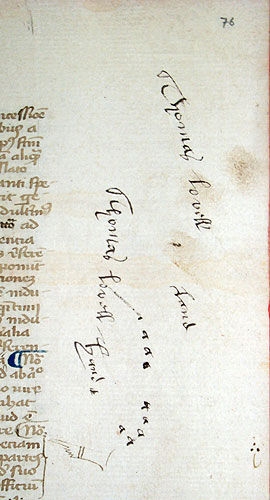
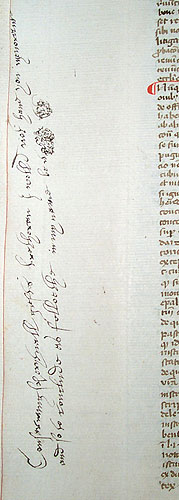
2. Inscribed by a number of 15th-16th century readers with pointing hands and marginalia in Latin relating to the text, and with 16th-century marginalia in English, unrelated to the text, e.g. 'Thomas Lovell hand' (twice, fol. 76r; there were men of this name at both Oxford and Cambridge in the 16th century); 'Conserning sperytuall giftes bretheren I wolld not haue you genorous(?) and so to conclude as folloethe in my name be it [followed by initials?, now effaced]' (fol. 279v); 'This is my name But whose name' (fol. 310v); see also fols. 62v, 86r, 123r, 177v, 242v, 244v, 305v, 314v, etc., with sums of money on fols. 194v, 220v.
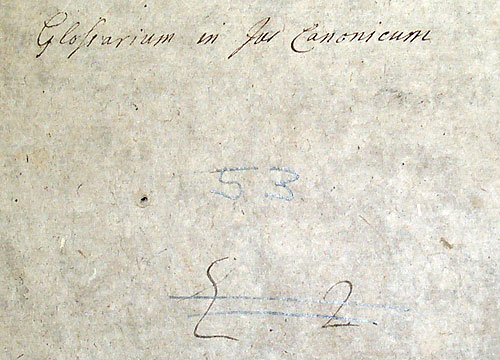
3. Queen's College: acquired probably in the later 18th or early 19th century; inscribed on the inner face of the front board 'Glossarium in Jus Canonicum' (described with exactly the same words, as an addition to the early 18th century handlist in MS. 557), and inscribed with the old shelfmark 'E. 2.' in ink (cf. spine label), crossed through and inscribed '53' in pencil.
Coxe, Catalogus, p. 8.