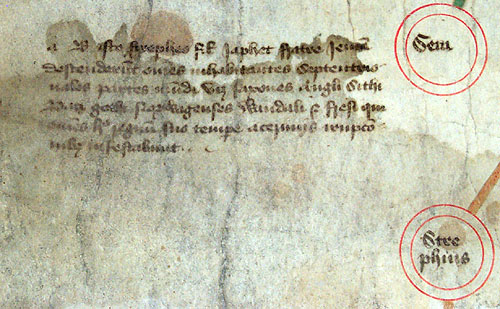
Roll chronicle of the kings of England, deducing their descent from Noah down to Henry VI; the left-hand column beginning: 'Ab isto strephes [sic] filio Iaphet fratre Ieman descenderunt omnes inhabitantes septentrionales partes mundi viz saxones angli …'; the right-hand beginning, with areas of damage: 'Ab hijs tribu[s filiis n]oe texuntur generaciones septuaginte du[e post linguarum] diuisionem factam in edifica[cione turris bab]el …' (this passage is also found in the more common text starting 'Considerans …', which includes the antediluvian descent from Adam and Eve); next to Edward the Confessor is the 'Prophecia regis edwardi dum ageret in extremis sibi diuinitus reuelata. Arbor quelibet viridis …' and the 'Exposicio prophesie. Arbor hec anglorum regnum gloria foliorum …'; the last paragraph concerns the newly quiet character of the Welsh in the reign of Henry IV, here applied to that of Henry V: 'Primo anno henrici quarti surrexit in wallia quidam owynus Glendor' … poli lio. io cao 38. … faleratus dicior hec ille.', referring to, and taken mainly from, Ranulf Higden's Polychronicon (cf. RS, I, pp. 410-2).
The main line of descent is from Noah to Henry VI (1422-61); the last Archbishop of Canterbury included is Henry Chicheley (1414-43).
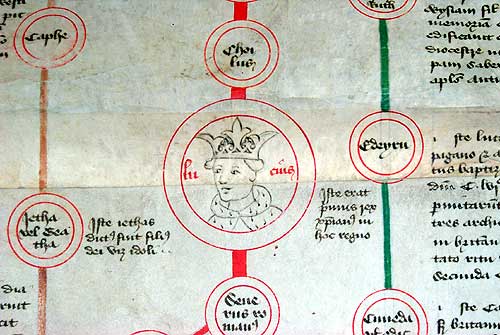
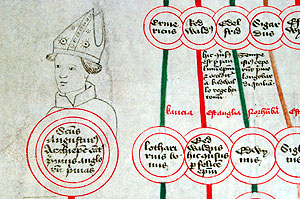
The genealogy is in the form of a central line in red, with branches to either side in green or brown, with names written in two concentric circles; a few names are in red, and/or in larger circles: 'Noe' is at the top, in the largest circle; the others in red are 'Brutus 34 an'', 'lucius', and 'Henricus sextus'.
The text also occurs in (i) Bodleian Library, MS. Bodl. Rolls 10 (Summary Catalogue, no. 2967; Pächt & Alexander, III, no. 927), from which the missing text is supplied above; (ii) Cambridge, King's College, MS. 43, (iii) BL, Lansdowne MS. 2 (on these two see Ker, MMLB, II, p. 229); (iv) BL, Harley Roll c. 5; and (v) a single membrane in the Library at Ampleforth Abbey (in Box LX65). Indiana, University of Notre Dame, MS. 40, seems to contain a closely related text in codex form, but ends with Henry IV (see James A. Corbett, Catalogue of the medieval & Renaissance manuscripts of the University of Notre Dame (Notre Dame, 1978), p. 180. Oxford, Brasenose College, MS. 91 is said by Ker (MMBL, III, pp. 601-2) to be a hybrid of the more common text starting the descent from Adam, attributed to Roger Alban (cf. Queen's, MS. 168 below), and the text of the present manuscript.
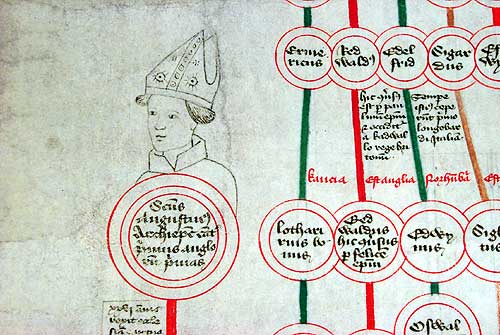
Two drawings of male busts; apparently drawn in leadpoint, then inked-over:
(Juncture of membranes 2 and 3) Lucius, the first Christian king, crowned, and with fur-trimmed collar.
(Membrane 3) St. Augustine, first Archbishop of Canterbury, wearing a mitre but not nimbed.
There is a very large elaborate crowned 'H' for Henry VI.
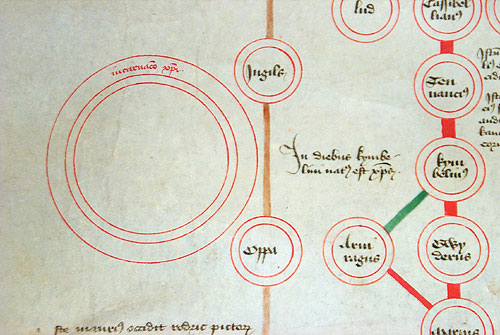
A large roundel with the rubric 'incarnacio xpi' has been left empty (membrane 2); in MS. Bodl. Rolls 10 this roundel contains a depiction of the Nativity (see Pächt & Alexander, pl. LXXXIX; the large roundel at the top of the Bodleian roll has a depiction of Noah's ark, but here the name Noe has been written in the middle of the equivalent roundel, so it is uncertain whether such an illustration was ever envisaged.
The choice and disposition of the decoration is closely related to the Bodleian, King's College, and Lansdowne manuscripts.
Parchment; c. 5650 x 295 mm; the top of the roll tapered, and damaged with loss of text to the right-hand side; the first membrane becoming detached from the second.
7 membranes; each membrane c. 800-900 mm long, except the last, which is shorter, at c. 570 mm.; numbered 1-7 in modern pencil.
Written in an anglicana script; guide letters were supplied by the scribe for coloured/gilt capitals which were never executed.
Not applicable.
1. Written after Henry VI's accession (1422), and presumably before Archbishop Chichele (d. 1443) had been succeeded by Archbishop John Stafford (1443-52).
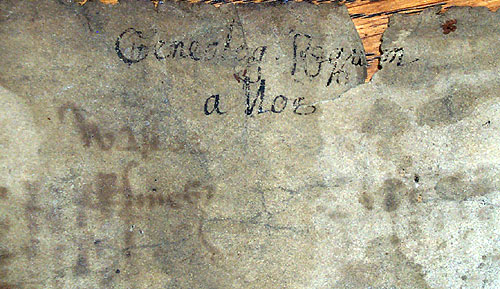
2. Inscribed, 15th century: 'Walter | pertinet' (faded, but legible with a UV lamp; dorse of membrane 1).
3. Inscribed, 16th century, with various comments, from the issue of Edward III onward, including several relating to his son John, duke of Lancaster, and the latter's wives (e.g. 'this duke of Lanncaster had iij wyfes to wit blannche constance & katheren'; there is also a large erasure next to Katherine Swynford, his third wife; membrane 7); the person responsible for these additions also extended the descent of Richard, duke of York (1411-60) [m. Cicely in 1438], and John of Somerset (c.1373-1410), down to Edward V (1470-83).
4. Inscribed, 17th(?)-century: 'Geneolog. Regum | a Noe' (next to the 15th-century inscription).
5. Queen's College: the dorse of the final membrane inscribed 'Archives M. ['12.'and '14.' crossed through] 15' (in the shelflist in MS. 557 it is 'M. 14'); with a College bookplate inscribed '167'.
Coxe, Catalogus, pp. 38-9.
[Not in Temple & Alexander, College libraries]