[Items 1-2 occupy quire 1]
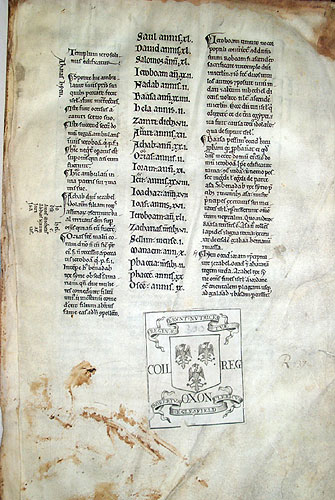
1. (fols. 1r-2r) Lists of kings of Israel, Juda, and Chaldea, with historical notes on their reigns, annotated with the names of prophets who lived during their reigns: 'Saul annis .xl. | Dauid annis .xl. | ... |.'; the first glosses (not in Stegmüller, RB) to either side are 'Templum ierosolimis edificatur ...', and 'Ieroboam timuit ne cor populi conuertetur ad dominum suum Roboam ...' (cf. BL, Cotton MS Claudius E V, fol. 256r, and Additional MS. 54229, fols. 1v-2r, both from Christ Church, Canterbury).
2. (fol. 2v) Seven glosses: '[L]iber regum apud nos .iiii.or distinctionibus clauditur …' (Stegmüller, RB, no. 304); followed by six from the Glossa ordinaria: Stegmüller, RB, nos. 11789 (6), (2), (3), (7), (5), and (8).
[Items 3-4 occupy quires 2-18]
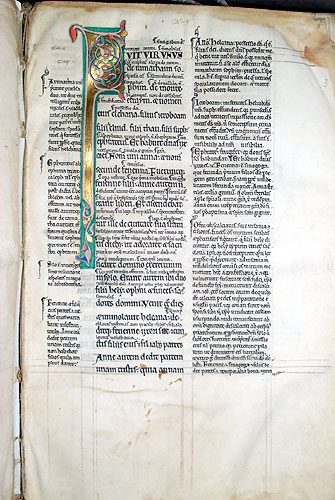
3. (fols. 3r-135v) I-II Samuel, I-II Kings, with the Glossa ordinaria: the first glosses of I Samuel are Stegmüller, RB, nos. 11789 (9) and (10), to the left and right respectively.
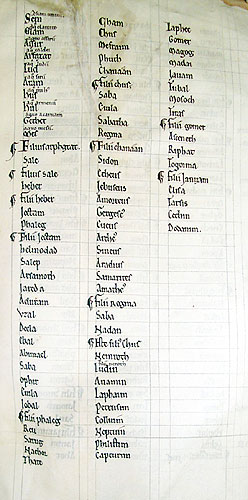
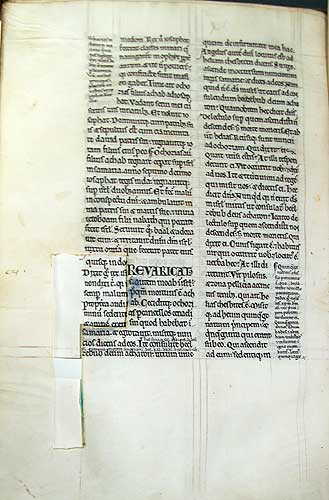
4. (fols. 136r-137r) Table of patriarchs and their sons: 'Sem \Asiam tenuit/ | Elam \aquo elamite(?)/ | Assur \aquo assirii/ | ... Filii leui | Cahat | Gerson | Merari.'; most of fol. 137 cut away, the verso blank.
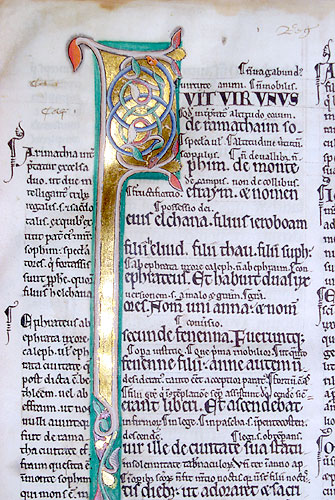
One (of an original four or five?) illuminated inital, 'F', about half the height of the page, with scrolling foliage terminating in 'lion' heads, on a gold ground; edged in green (fol. 3r). Further initials excised at fols. 38r, 66v, and 108v; there was perhaps also originally another at the start of text item 1. There is fine pen-drawn foliate decoration descending from the bottom lines of text in a few places (fols. 64v, 66r).
Parchment, c. 335 x 220 mm.; of generally good quality; the outer margin of fol. 104, and most of fol. 137, cut away.
ff. 137, foliated in modern pencil: 1-137, except for fols. 31, 58, which have a 19th-century pencil foliation, which also had fols. 136-137 incorrectly foliated as 135-136.
Quires mostly of eight leaves each: 14-2 (1st & 2nd leaves excised) (fol. 1-2) | 2-178 (fols. 3-130), 188-1 (8th leaf cancelled) (fols. 131-137); quire signatures survive in most quires, usually in upper-case roman numerals in ink in the first half of the volume, usually in 'crayon' in the second half, and in lower-case numerals towards the end.
Ruled in leadpoint, the top and bottom horizontal line extending the full width of the page, vertical bounding lines ruled on an ad hoc basis from page to page; the overall ruled space c. 210 x 140-5 mm.; prickings survive in all four margins.
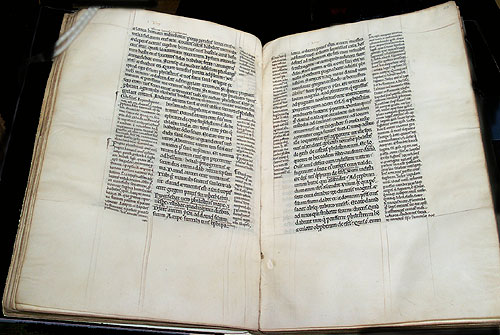
Written usually in two or three columns of variable width, with up to approximately 50 lines of gloss (variable), 'above top line', the biblical text on alternate ruled lines in a formal bookhand, the gloss similar, but smaller, less formal, and more heavily abbreviated (cf. de Hamel, Glossed books, p. 24, fig. 15, pl. 13).
Secundo folio: 'Nabugodon'', 'In .vii. anno' (fol. 2r, text, and left gloss).
Original medieval sewing on three slit (alum-tawed?) bands; head- and tail-bands worked with coloured threads; the boards and covers missing (the bands deliberately cut, rather than broken through age).
1. Written in England, perhaps in the west or south-west, c. 1175, according to Michael Gullick; the unusual first text suggests a possible link with Canterbury.
2. Queen's College; included in Gerard Langbaine's mid 17th-century catalogue (Bodleian Library, MS. Langbaine 7, p. 413) with the shelfmark Arch. B. 1. 2 (not now apparent in the manuscript); inscribed with a former College shelfmark 'R. 37' (fol. 1r), and with the College bookplate on fol. 1r inscribed in pencil '300'.
Bernard, CLM, p. 29 no. 929 (MS. 5).
Coxe, Catalogus, p. 70.
Alexander & Temple, College libraries, no. 132.