[Psalms 1-108 occupy quires 1-19, Psalm 109 to the end occupy the remainder]
1. (fols. 1r-210v) '[Prologue] Cum omnes prophetas sancti spiritus reuelacione constet esse locutos; ... qui abiit. stetit. & sedit. [the last lines of the prologue and the start of the biblical text missing due to the excision of the Ps. 1 initial] [Gloss:] [B]eatus cui omnia optata succedunt. uir scilicet contra prospera & aduersa; firmus. qui non abiit. ... Vite eterne uox est. Omnis spiritus laudet dominum.' (cf. MS. 302 for refs.); lacking Pss. 27:2-31:7 and Pss. 35:10-40:2 due to the loss of quires after fols. 40 and 48.
2. (fols. 211r-216v, and back pastedown) Various contemporary notes and inscriptions in leadpoint and 'crayon', including several lines of verse: 'si quid eras quid eris homo quid sis mente notaris | … ' (fol. 211v); the back pastedown also has notes and doodles in ink.
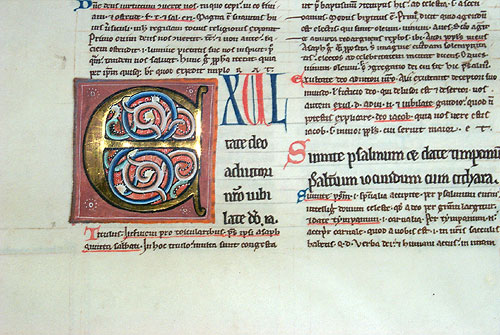
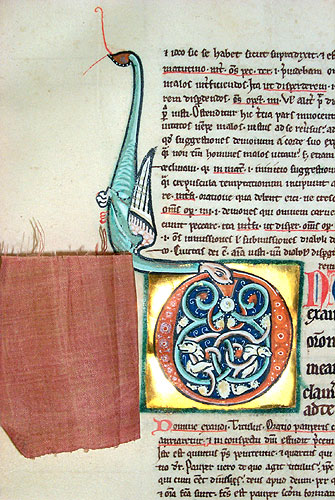
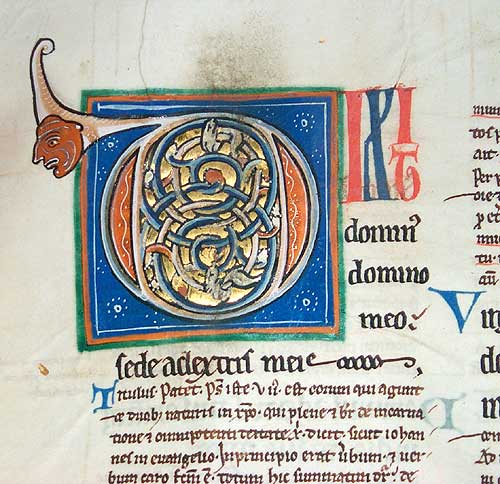
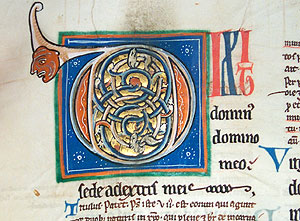
Four (of an original eleven) illuminated initials, each with the first few following letters of the text in alternately red and blue attenuated capitals:
The initials to Pss. 1, 26, 51, 52, 68, and 97, excised from fols. 2r, 38v, 64v, 65v, 88r, and 137v; the Ps. 38 initial would have been in the quire now missing after fol. 48; some traces of sewing for textile veils survive.
Two-line initials alternately in red with predominantly blue pen-flourishing, or vice versa, to psalms, often with colour-notes visible, 'R' for red, and 'A' for blue (azure) in leadpoint (e.g. fols. 17r, 18r, 19r, 19v, 23v, etc.), or red ink (fols. 9r, 27v, 30r, 31r, etc.); one-line initials alternately plain red or blue, to verses; smaller initials alternately plain red or blue, at the start of each section of gloss.
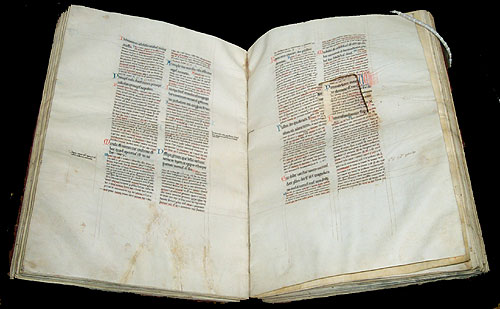
Parchment, c. 360 x 245 mm.; of average quality, with a number of flaws.
ff. 216, foliated in modern pencil: 1-216, except for fols. 211 and 216, foliated in 19th-century ink.
Quires mostly of eight leaves each: 1-58 (fols. 1-40), [quire missing], 68 (fols. 41-48), [quire missing], 7-188 (fols. 49-144), 196+1 (last leaf inserted) (fols. 145-151) | 20-268 (fols. 152-207), 276 (fols. 208-213), 284 (fols. 214-216 and the pastedown); fol. 151 is apparently pasted to both fols. 150 and 152, but it most likely originally belonged with fol. 150 at the end of quire 19 (as in the collation above), since it is common English practice for Psalm 109 to start on a new quire, and the preceding quire to be shortened or extended accordingly; catchwords present in most quires; quire signatures in lower-case roman numerals, usually in brown ink in the first half of the volume, and usually in 'crayon' in the second half of the volume, but occasionally in red ink as well as or instead of these (fols. 56v, 64v, 175v).
Ruled in leadpoint in two equal columns throughout, usually for up to 58 lines of Gloss per page, written above the top line; the1st & 3rd, 28th & 31st, and 56th & 58th horizontal lines extending the full width of the page; between pairs of vertical bounding lines, and three inter-columnar lines, extending to the prickings or the full height of the page; the ruled space c. 218 x 120 (127 including bounding lines) mm.; prickings in the inner, usually also in the upper and lower margins, occasionally also at the fore-edge.
Written in two columns with the biblical text written on alternate lines, interspersed by the Gloss, in a fine formal bookhand in two sizes.
Secundo folio: [mo]'tum mentis'.
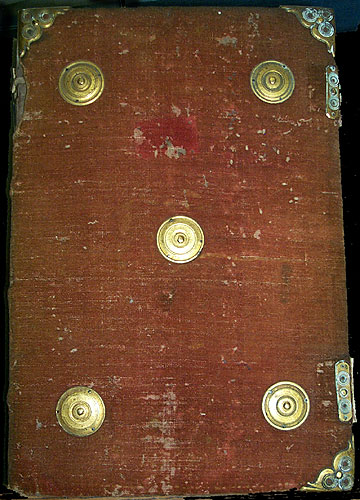
'Henry VIII binding'. Sewn on four slit (alum-tawed?) thongs, laced into oak boards with slightly rounded edges flush with the leaves; covered with later red velvet; each board with five rather flat round bosses and two openwork corner-pieces; two matching intact pierced clasps at the fore-edge; the front board also with the vestiges of a title-piece between the middle and upper bosses; the front board split in two vertically but held together by the velvet covering and parchment pastedown; the bands broken or weakening at the front joint; the upper covering of the spine missing; the spine with a paper label printed '40'.
1. Written in England probably in the early 13th century; with numerous early marginal annotations throughout the text and on several blank leaves at the end
2. Various doodles on the back pastedown, including a 14th-/15th-century notary's mark shaped like a monstrance, incorporating the letters 'lb ma' on the base.
3. Inscribed, 16th(?) century 'Aug. super psalterium' (fol. 1r), 'Quinquagena D. Augustini' (fol. 210v); the same hand inscribed MS. 302; also inscribed '84.4' (corrected from '84.5') on the front and back pastedowns (cf. MSS. 302, etc.).
4. Inscribed by Gerard Langbaine (?): 'Imo Commentarius collectus ex Augustini, Remigij, Cassiodori, et aliorum commentarijs in psalmos' (fol. 1r), 'Ecclesiam pro naue rego; mihi climata mundi. Sunt mare, scripturæ, retia; piscis, homo' (fol. 210r) (Walther, Proverbia, no. 6943).
5. Queen's College, by the mid 17th century, since it is included in Gerard Langbaine's mid-17th-century catalogue of Queen's MSS (Bodleian Library, MS. Langbaine 7, p. 412); also included in the 1689 catalogue in MS. 555, attributed to Augustine (see above, and cf. MS. 302); the front pastedown inscribed with the shelfmarks 'Arch. B. 2. 1.'; 'R. 40' twice (cf. spine); and 'C.27'; mostly crossed through; and with the College bookplate inscribed in pencil '303'.
Bernard, CLM, p. 29 no. 928 (MS. 4).
Coxe, Catalogus, p. 70.
Alexander & Temple, College libraries, no. 154, pl. VIII (fol. 141r, Ps. 101, detail).